
Discover if AIs find, cite, and recommend you. And if they don't, we'll tell you exactly why.
Try for free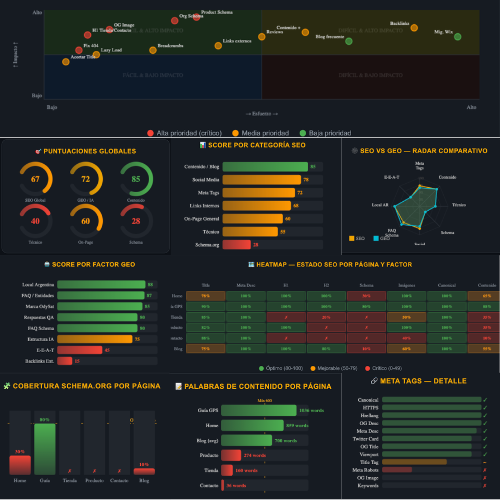
Every Nostos criterion rests on sources that publish their method and their data: peer-reviewed research, official technical standards, and the engines' own official documentation. Every reference is linked so you can go to the source and check it.
The reference benchmark is Aggarwal et al., KDD 2024, the first formal work on Generative Engine Optimization. One of its central findings: including citations, quotations from relevant sources and verifiable statistics raises a source's visibility by over 40% compared to content without numerical backing.
The analysis takes between 30 and 60 seconds and evaluates data density, freshness and updates, direct question-answer relevance, thematic specificity, sub-question coverage, technical markup, content structure, and authority and trust.
Nostos was developed by Fabián Torres, GEO specialist and founder of Odisea e-Store, an e-commerce agency founded in September 2010 with over 15 years of experience in Argentina. The evaluation criteria are reviewed every three months to reflect changes in language models.
Criteria are periodically reviewed against current research and guidelines.
GEO Analyzer Based on academic research (Aggarwal et al., KDD 2024) and official technical standards
Last updated:
You'll receive a copy of the report in your email.
Al enviar, aceptás nuestra Política de Privacidad y nuestros Términos de Uso.
Accediendo al sitio...
Applied academic research so AIs find and cite your site.
Most websites aren't ready to be cited by an AI. These numbers confirm it.
The Argentine e-commerce figures come from our own study of 39 leading domains in the sector, with sample and methodology published. <a href="/en/ecommerce-argentina-geo-visibility-study.html" style="color:var(--negro);font-weight:600;">Read the full study →</a>
We analyze your site in seconds and tell you if AIs find you, which criteria you're not meeting, and how much work it takes to fix them.
We rewrite and reorganize your content so that language models understand it, cite it, and recommend you.
We identify how your competition is positioned before AIs and what they do better than you. Then we help you surpass them.
AIs change their recommendation criteria. We monitor your site and apply the necessary updates so you don't lose your position.
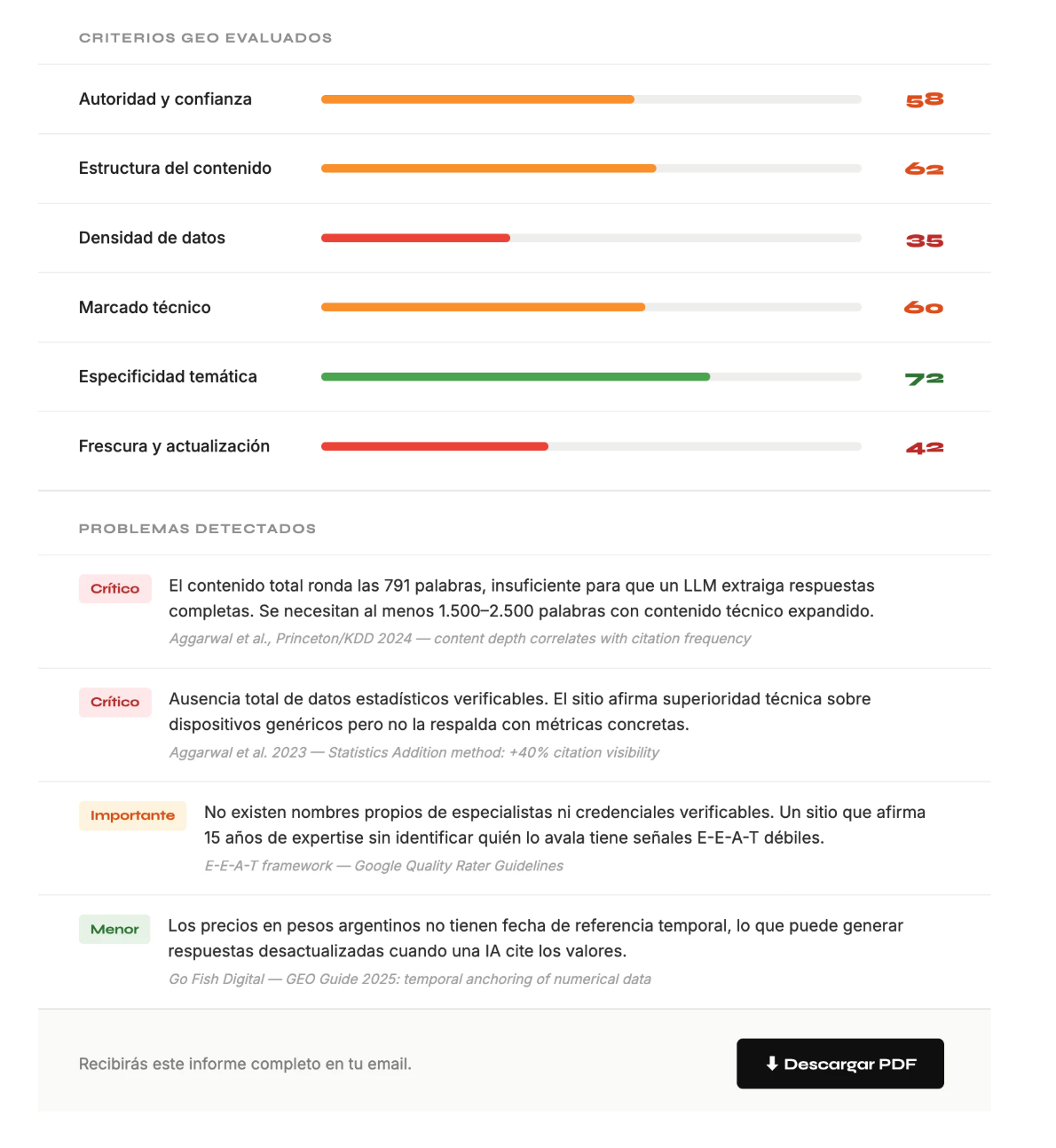
A complete, immediate reportGlobal score for your site, criterion-by-criterion evaluation and a list of issues ordered by severity — all backed by academic research.
Visual GEO DashboardClear charts that show at a glance where you're doing well and where you need to work. Easy to share with your team without technical explanations.
PDF DownloadThe report is yours to share with your team, developer, or decision-maker.
A personalized action plan by emailWe review your report and send you a concrete proposal: what needs to be done, in what order, and how much it costs for us to do it.
GEO stands for Generative Engine Optimization. It's the discipline of optimizing your website so that AI models — ChatGPT, Claude, Gemini, Perplexity — find, cite, and recommend you when someone asks about your industry. Today, millions of people ask an AI what to buy, who to hire, or where to look. If your site isn't GEO-optimized, those people will never reach you.
Yes, completely. You enter your email and website URL and receive the report at no cost. If you'd then like us to implement the fixes, we'll send you a detailed proposal with costs.
We use it to send you the report and, if applicable, a work proposal. We don't share it with third parties or send you ads.
Between 30 and 60 seconds depending on your site's size.
No. The report is written in plain language, no jargon. If something isn't clear, we're available on WhatsApp.
SEO optimizes a site to appear in search engine results like Google. GEO optimizes content so AI models — ChatGPT, Claude, Gemini, Perplexity — cite and recommend it in their responses. According to Aggarwal et al. (KDD 2024), the strategies that most increase AI visibility differ from traditional SEO: including citations, quotations from relevant sources and verifiable statistics raises a source's visibility by over 40%.
Sites that benefit most are those wanting to be recommended when someone asks an AI about a product, service, or expert: online stores, independent professionals (lawyers, accountants, doctors, consultants), agencies, B2B suppliers, and brands competing in niches where an AI recommendation can define a purchase. The more specific the niche, the greater the potential GEO impact.
Language models like ChatGPT or Gemini were trained on large volumes of internet text. They learn to associate certain sites with authority, accuracy, and topical relevance. In real time, models like Perplexity also actively crawl the web. The most influential factors are: the presence of verifiable data, clarity of content structure, authorship signals (who wrote it and with what credentials), and Schema.org technical markup that lets the AI read the site in a structured way.
A JSON-LD schema is a block of code added to a site's HTML to describe its content in a structured way: what type of organization it is, who founded it, what services it offers, what questions it answers. AIs can read this markup directly, without having to interpret the text. With that markup, a system reads the information declared; without it, it has to infer it from the visible text, and inferences are less reliable than explicit declarations. It's the difference between being an identifiable entity and being anonymous text.
GEO isn't a one-time action: language models update constantly and their recommendation criteria change. Research by Chen, Wang, Chen and Koudas (University of Toronto) measured that the content AIs cite is noticeably more recent than what a traditional search returns —in consumer electronics, a median of 62 to 90 days versus 130— and concludes that content freshness is crucial in AI search ecosystems. We recommend a full audit every 3 months and content updates at least once a month to maintain your position.